John Green
My G-d saved me from the Holocaust and sent me to Fayetteville, North Carolina in Cumberland County. — The first line of his speech
The words on this page come from a speech John Green typed out himself: six pages, with his own pen corrections in the margins. He wrote it after 37 years of marriage to Ursula, which puts it around 1984. The section summaries in italics are added for context. Everything else is his own words, with only spelling corrected.
A Life's Journey
- 1920Born May 8, the youngest of five, in Nassau an der Lahn, a small town near Koblenz
- 1924His father, the merchant Jakob Grünebaum, dies April 11 at 47; Hans is almost four
- 1927His sister Beatrix dies at eighteen
- 1933Hitler comes to power; Nazis picket the family store on April 1, and his brother Leo flees
- 1934Finishes school at 14 and goes alone to Holland as a baker's apprentice in Apeldoorn
- 1937Makes candy at the Paris World's Fair, then lands in New York on November 11
- 1938Works in bakeries in Manhattan, then moves to North Carolina
- 1941Drafted into the U.S. Army and does basic training at Fort Bragg
- 1943Camp Hood, Texas: cooking instructor, then supply sergeant
- 1944Lands in England, then Normandy, and is assigned to the Military Intelligence Service
- 1945Among the first GIs at Dachau; Bronze Star; meets Ursula
- 1946Buys a Fayetteville salvage yard with Harold Cohen, which becomes Cohen & Green
- 1947Marries Ursula on February 19
- c. 1977Buys out his partner; sons Michael and Ronald join; expands to Raeford and Lumberton
- 1984Receives the Salvation Army Others Award
- 1984Dies May 1 at age 63, one week before his 64th birthday
Early Life in Nassau
Hans Gruenebaum was born in Nassau, a small spa town on the Lahn River about 20 km southeast of Koblenz. His family ran a store in town. He lost his father before he was four, and his childhood ended under the Nazis: he left for Holland alone at fourteen.
Nassau an der Lahn and the Koblenz region, Germany
His speech says only “a small town near Coblenz,” and a later profile names Coblenz itself. German records identify the town as Nassau an der Lahn (see below).
I was born in Germany, May 8, 1920 in a small town near Coblenz, Germany. We were a family of 5 children and my parents; Leo, Max, Beatrix, Ruth and myself, I being the youngest. My family had a department store selling general merchandise. My father passed away when I was 4 years old. I was unable to finish High School due to Hitler coming into power. My formal education stopped at age 13.
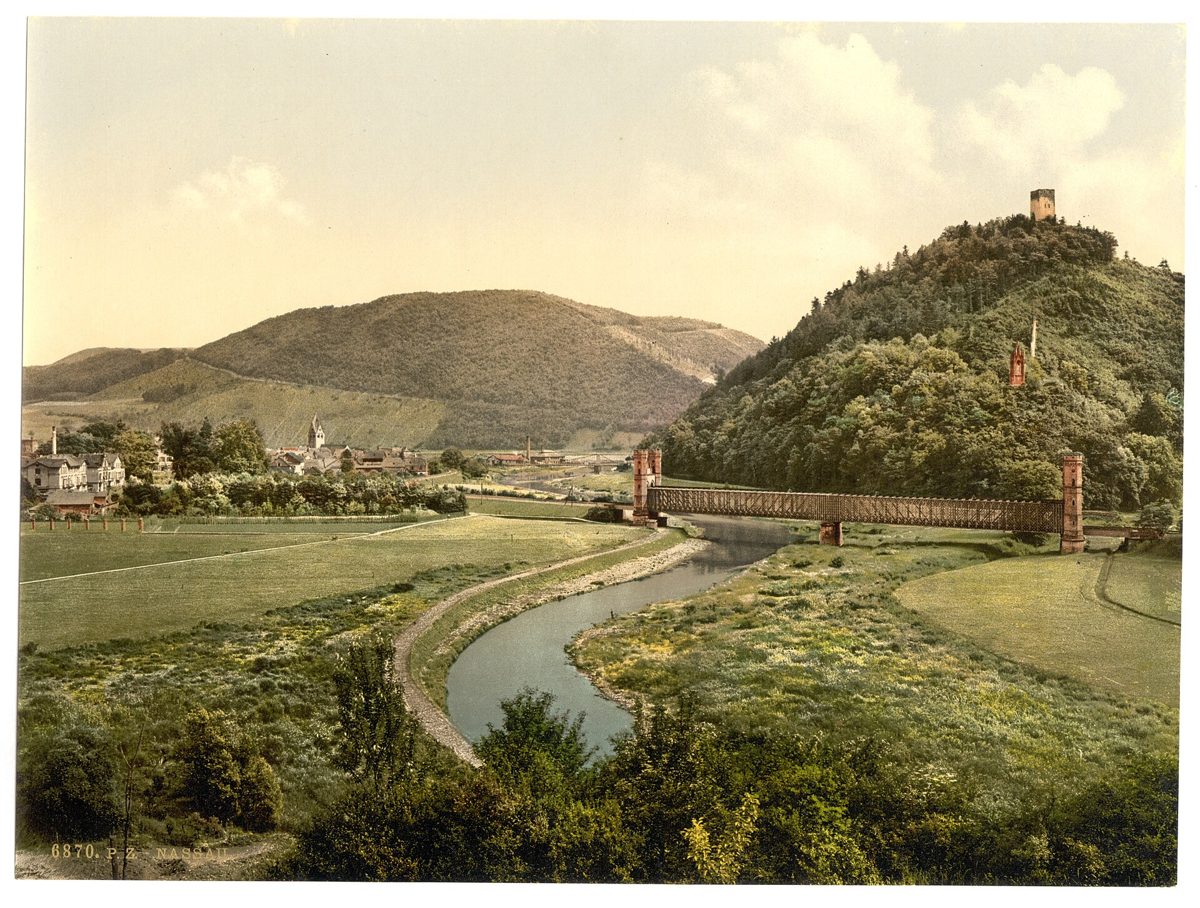
The Grünebaums of Nassau
German records name the town. When Hans's mother died, the New York German-Jewish weekly Aufbau ran a death notice on December 15, 1944, for “Johanna Grünebaum, früher Nassau/Lahn” (formerly of Nassau on the Lahn). The mourners listed include Leo and Margot Grünebaum of Washington, D.C.; Arthur and Ruth Goodman, née Grünebaum; Max Grünebaum of London; and “St. Sgt. Hans Green,” who was then serving in the U.S. Army (Aufbau, via Deutsches Zeitungsportal).
Most of what follows comes from the chapter on the Grünebaum and Löwenberg families in Julius Israel Nassau: Juden in einer ländlichen Kleinstadt im 19. und 20. Jahrhundert, by Waltraud Becker-Hammerstein and Werner Becker (2002). The Beckers researched Nassau's Jewish families for years and mounted the town's 2006 exhibit. The Stadtarchiv Nassau sent scans of the chapter and of Jakob Grünebaum's death record in November 2026. Passages from the book are translated from German.
The family came from Kehlbach, a village in the Taunus hills east of the Rhine, near Dachsenhausen. The family took the name Grünebaum in 1841, and its men were horse and cattle dealers. John's great-grandfather Herz Jacob Grünebaum traded horses in Nassau from at least 1833. His grandfather Löb Zadock Grünebaum, born in 1850, took over the trade and moved it from Kehlbach to Nassau in December 1880. He gave up the cattle trade around 1890 and died fairly young, shortly before 1900. He is buried in Nassau's Jewish cemetery (Becker-Hammerstein and Becker, Julius Israel Nassau (2002), pp. 179–180). Löb Grünebaum led Nassau's Jewish community from 1886 to 1889 (Obermayer Award nominations, 2011).
The family home stood on Oberstraße (today Obertal 14), between the synagogue and the property of Benzion Rosenthal. The lot was narrow, and the two families shared the driveway to the courtyard. The Beckers note dryly that this led to plenty of neighborly quarreling, or Kräsch in the Nassau dialect (Becker-Hammerstein and Becker, Julius Israel Nassau (2002), p. 180).
The Store: Jakob Grünebaum, Nassau
The family dated the firm to 1895. It is not clear whether Löb Zadock or his widow, Rosalie, opened the first small shop. Their son Jakob, John's father, was born in Kehlbach on December 21, 1876. In 1903 he married Johanna Löwenberg, daughter of the Nassau shoe and leather merchant Michel Löwenberg. He took over his mother's shop and registered it as a general store on January 10, 1904 (Becker-Hammerstein and Becker, Julius Israel Nassau (2002), pp. 180–181, 190).
That meant what it said. His ads offered sofas, bicycles and sewing machines, herring, fabrics and inexpensive menswear, furs, rollmops and Limburger cheese, dry goods, housewares and furniture. As the business grew, the herring and rollmops disappeared, and the store settled on men's and boys' clothing, bicycles and furniture. By 1910 it had telephone number 33. From 1913, master upholsterer Heinrich Kreidel ran a workshop for the store, and in 1914 the German patent office registered Jakob's design for a multi-part spring-frame mattress. The Grünebaums always had Christian employees, and Kreidel worked for the family for more than twenty years (Becker-Hammerstein and Becker, Julius Israel Nassau (2002), pp. 181–182, 186).
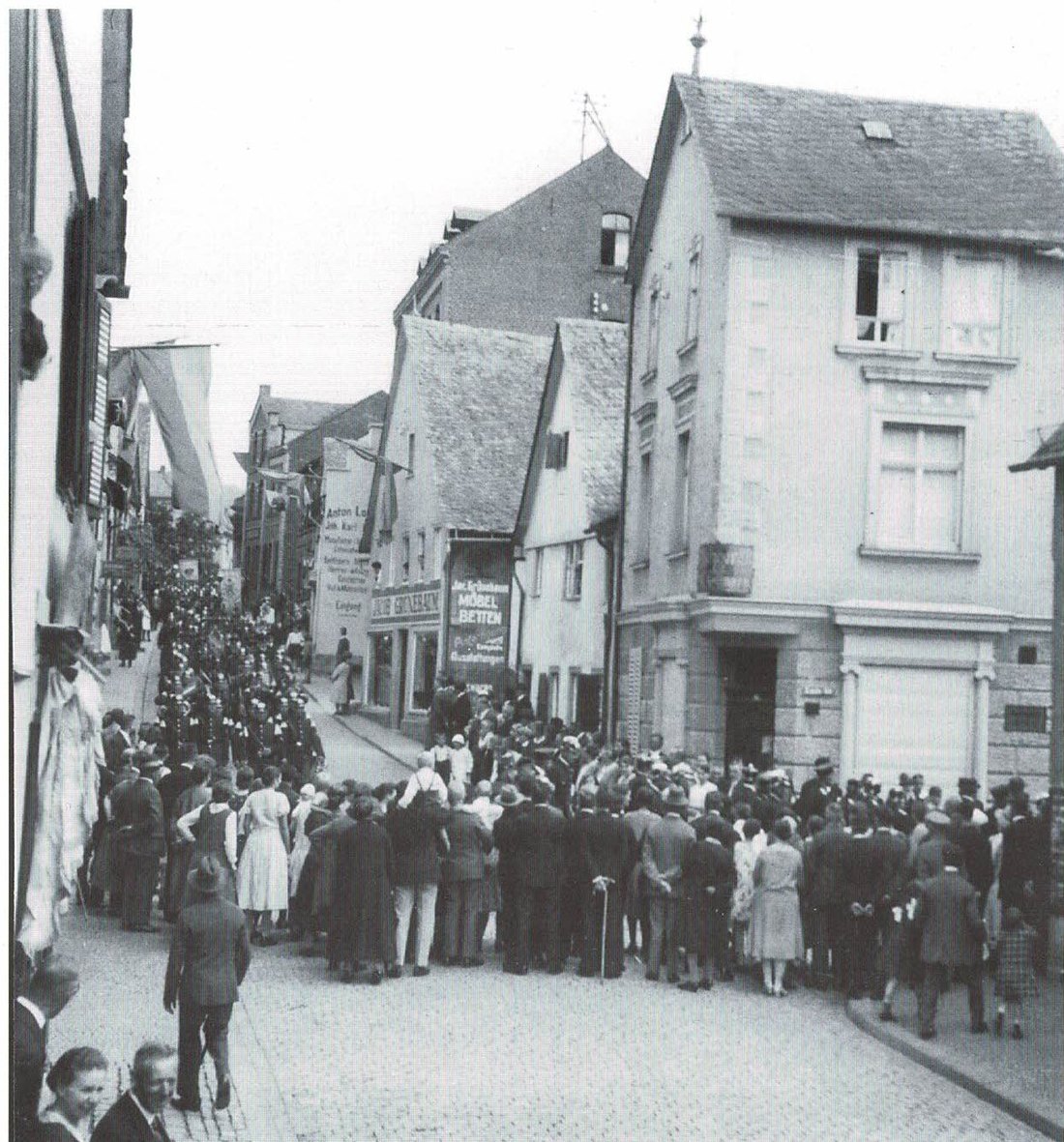
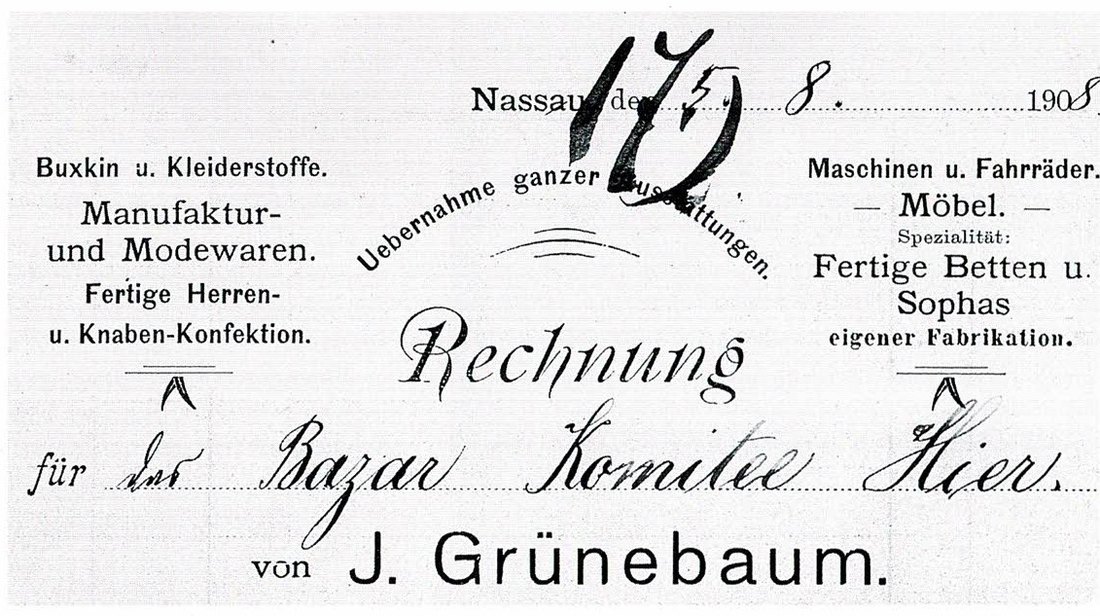
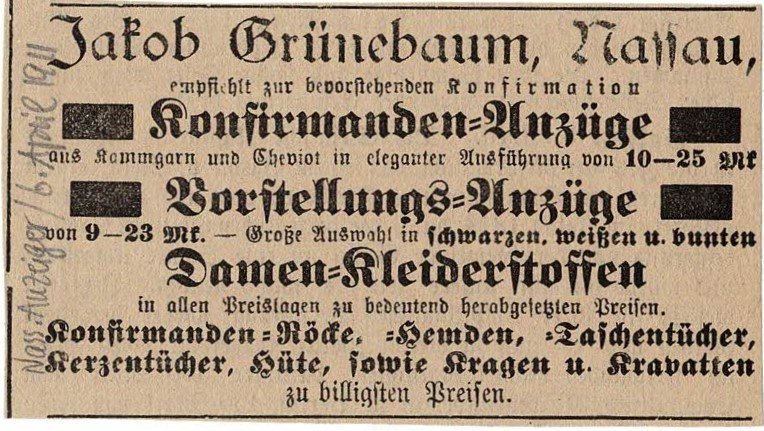
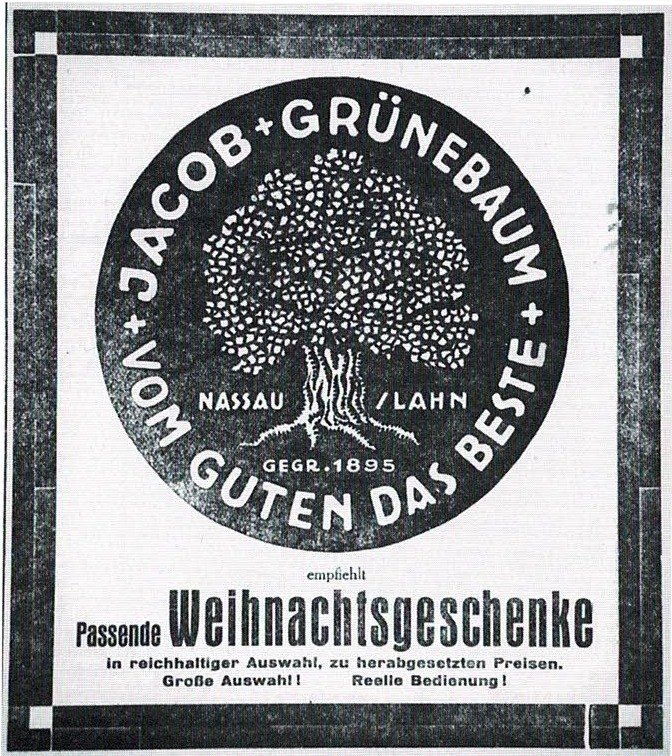
Jakob was a member of the volunteer fire brigade and served on several of its committees. He also belonged to the shooting club, alongside the mayor, the doctor, the chief forester and the pharmacist. He was a devout man, and as was customary the store closed on the High Holidays (Becker-Hammerstein and Becker, Julius Israel Nassau (2002), p. 182).
His Father's Death
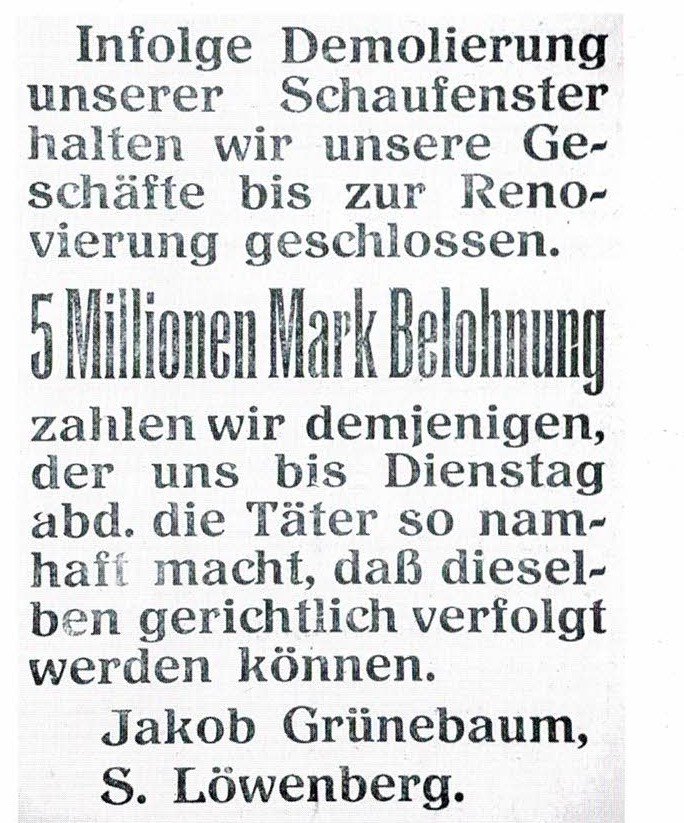
On the night of August 4, 1923, at the height of the inflation, someone threw stones through the shop windows of Jakob Grünebaum and his brother-in-law Sally Löwenberg. The Beckers call it an obviously antisemitic attack. The town imposed a curfew on young people, and the two merchants offered a reward for the culprits, without success (Becker-Hammerstein and Becker, Julius Israel Nassau (2002), p. 183).
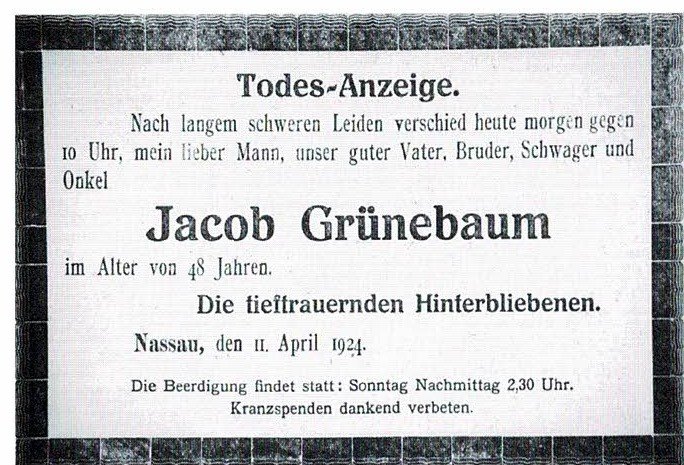
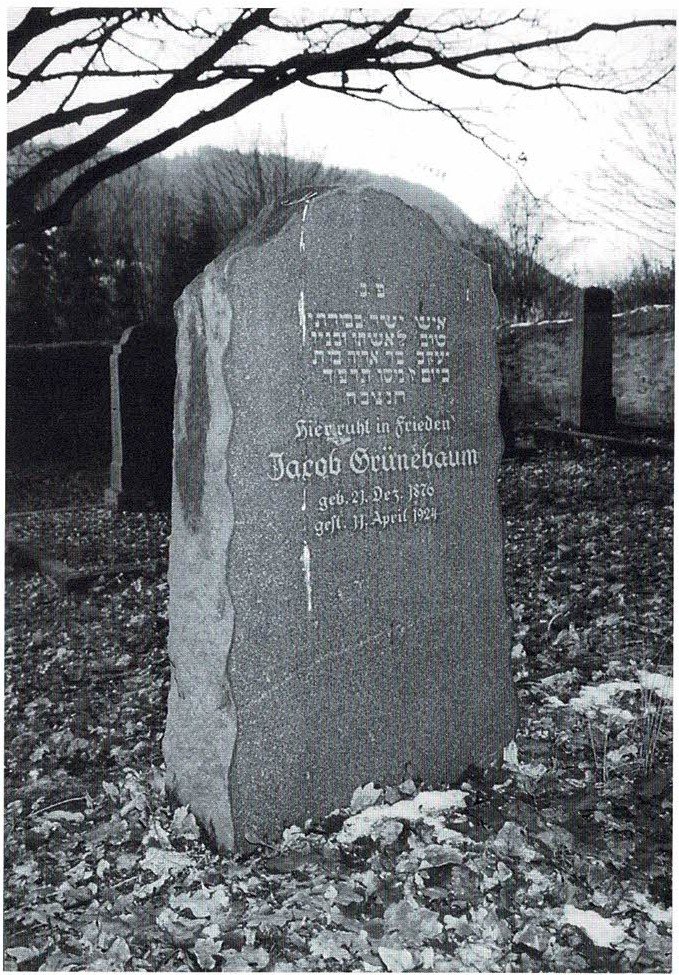
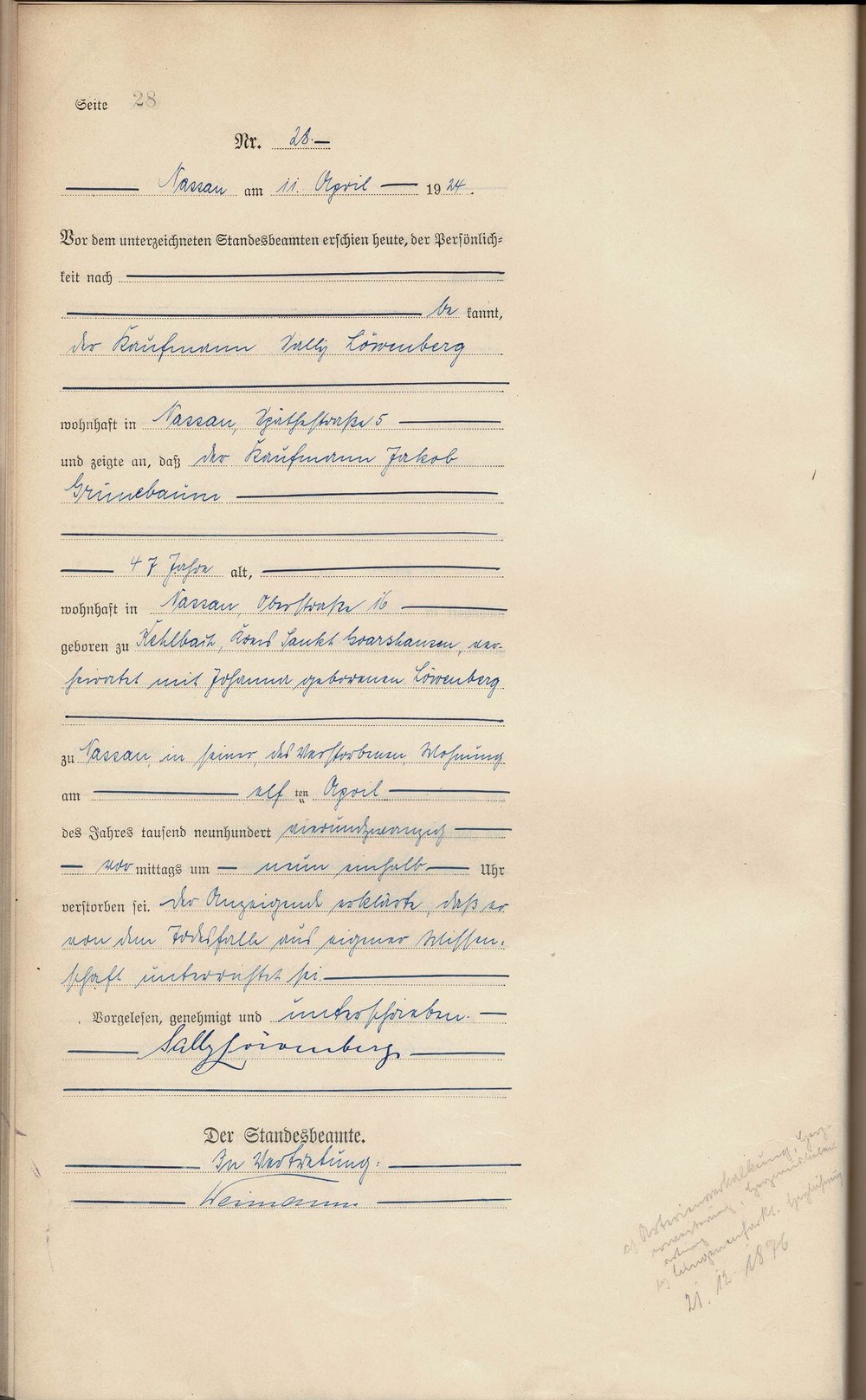
Jakob had been visibly ill in his last years. He died at home on the morning of April 11, 1924, at 47. His death notice speaks of “long, severe suffering.” In pencil, the register entry gives the causes as hardening of the arteries, an enlarged heart and degeneration of the heart muscle, followed by a pulmonary infarction and heart failure (Nassau civil register, deaths 1924, no. 28; Stadtarchiv Nassau). He is buried in Nassau's Jewish cemetery in a double grave, but Johanna, who died in North Carolina, does not lie beside him (Becker-Hammerstein and Becker, Julius Israel Nassau (2002), pp. 182–183).
Family memory held that John's father was a cattle dealer who was gored by a bull. The records do not support that for Jakob, who was a merchant and died of heart disease. The horse and cattle trade belonged to the generations before him, his father, Löb Zadock, and his grandfather, Herz Jacob, so the story may have come down from one of them.
Johanna and the Children
Johanna Grünebaum, who had held signing authority since 1919, took over the business. Her older children were still in training, and her youngest son was not yet four. One Nassau resident recalled that she “didn't let anyone take the butter off her bread.” The Beckers describe her as capable, energetic and fearless. In the 1920s she chaired the Association of Jewish Women of Nassau and the surrounding area, a charitable group with 65 members (Becker-Hammerstein and Becker, Julius Israel Nassau (2002), p. 183); she still held the post in 1932 (Alemannia Judaica).
Leo, born in 1904, trained in business in Frankfurt from 1920 to 1923. In 1928 the firm was formally put in his mother's name, and Leo received signing authority and ran the store from then on (Deutscher Reichsanzeiger, February 18, 1928; Becker-Hammerstein and Becker, Julius Israel Nassau (2002), p. 183). He was handsome and outgoing, the heartthrob of the town's young women. He organized masked balls at Carnival, and in 1930 he became treasurer of the Nassau Red Cross. Leo and Max were both artistically gifted and painted many Nassau scenes, and Leo designed the store's ads and its green-tree logo. Max, born in 1906, was often ill and showed early signs of Parkinson's disease, yet he was a mainstay of the store. When women customers were too sparing with cloth for a dress, he would quip in dialect, “obbe nix, unne nix, un' in de Mitt' en Hohlsaum” (nothing on top, nothing below, and a hemstitch in the middle), a line many in town long remembered (Becker-Hammerstein and Becker, Julius Israel Nassau (2002), pp. 183–184).
Beatrix, born in 1908, was known around town as “Grünebaums Bertris.” A contemporary remembered a pretty girl who often wore a lilac blouse with a large collar. As a teenager she put herself on a weight-loss diet, “with the wrong means,” and died of its effects in the Nassau hospital on May 22, 1927, at eighteen. The town was deeply moved. The funeral procession stretched nearly a mile (1.5 km) to the Jewish cemetery, and her brothers designed her gravestone in the shape of a Star of David (Becker-Hammerstein and Becker, Julius Israel Nassau (2002), pp. 184–185).
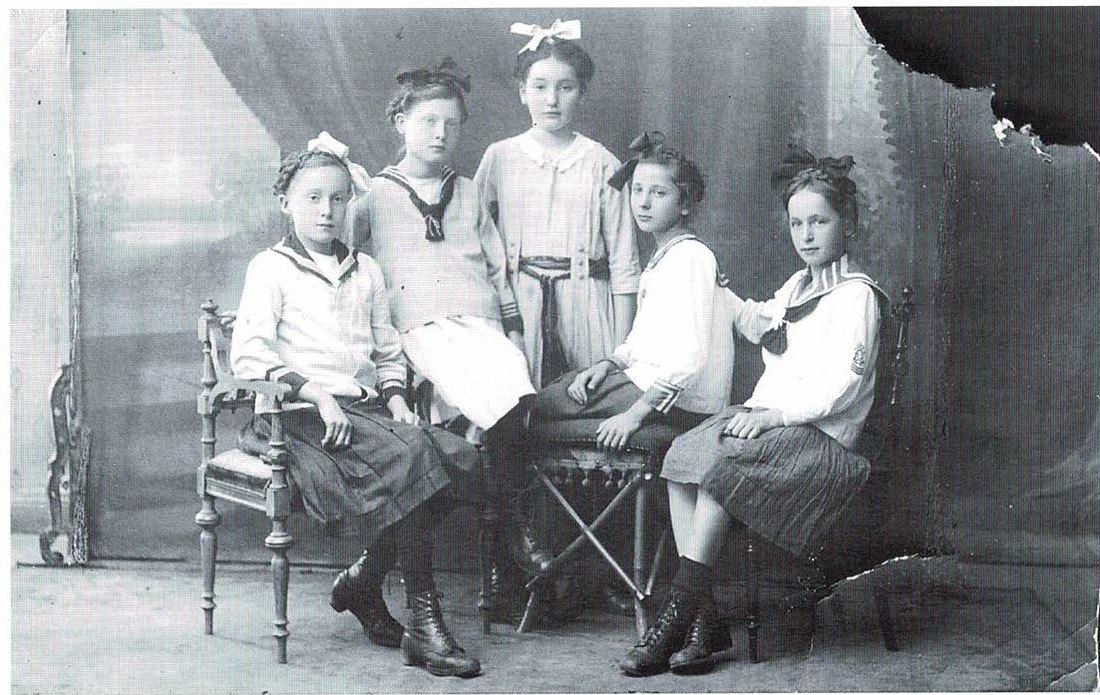
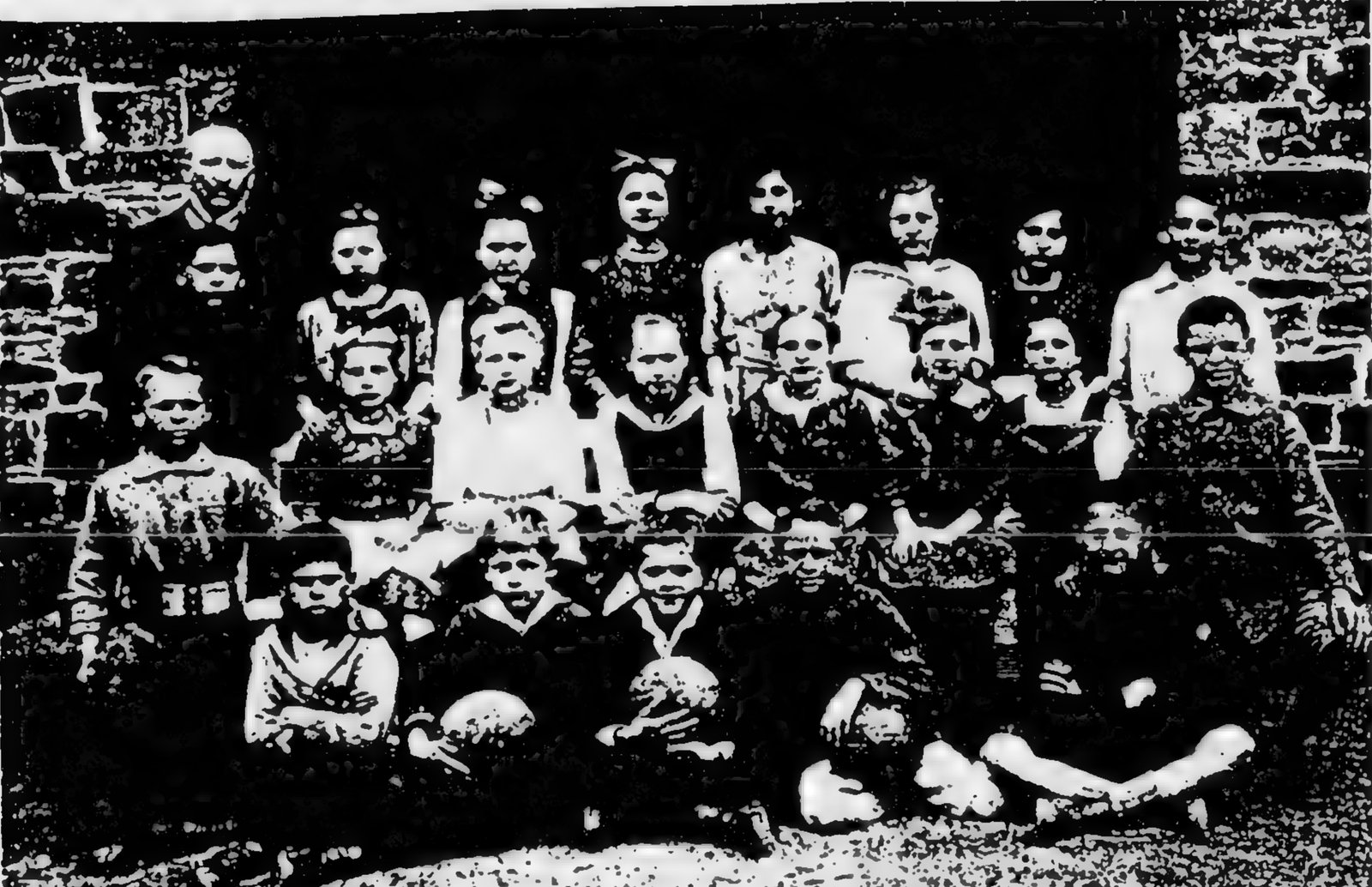
Ruth, born in 1916, and Hans, born in 1920, were the late arrivals. Like their brothers and sister they went to school in Nassau, but by the time they left school, Jewish families were being shut out of the town's social life (Becker-Hammerstein and Becker, Julius Israel Nassau (2002), p. 185). The Grünebaums kept investing in the store until the end: a second large display window in 1929, a remodeled shop in 1930 and garages in their garden near the station in 1931. They hoped to grow the firm into a home-furnishings house, but the hard times slowed them down (Becker-Hammerstein and Becker, Julius Israel Nassau (2002), p. 186).
The Nazi Years
On April 1, 1933, the day of the national boycott of Jewish businesses, the local Nazi party leader stood in full uniform in front of the Grünebaum store holding a sign that read “Don't buy from Jews,” and scared customers away. Most people in Nassau knew that the counter in his own barbershop, across the street, had come from the Grünebaums and had not yet been paid for (Becker-Hammerstein and Becker, Julius Israel Nassau (2002), p. 186).
Leo was in the greatest danger. On June 25, 1933, he was reported to the police for using the hymn “A Mighty Fortress Is Our God” in a joke. Christian friends warned him that the SA was coming and helped him escape. On July 3 the authorities noted that he had “disappeared without deregistering.” In October 1933 he wrote from Luxembourg, and he went on to the United States, where as Leo Green he married Margot Goldmann of Hanover. He died before 1957 in Silver Spring, Maryland (Becker-Hammerstein and Becker, Julius Israel Nassau (2002), pp. 186, 189).
John remembered his schooling ending at 13. The Beckers write that Hans left Nassau right after finishing school, in the summer of 1934, to begin a baker's apprenticeship in Apeldoorn (Becker-Hammerstein and Becker, Julius Israel Nassau (2002), p. 186). Nassau's archivist notes that Jewish children were not expelled from German schools right after 1933. Fourteen was then the usual age to finish the eight-year Volksschule and begin an apprenticeship, so Hans most likely completed school in Nassau before he left.
In 1938 Ruth followed. She arrived in New York on May 5, 1938, with their mother's widowed sister, Lilly Rosenbusch. She worked for some years as a masseuse and later in her husband's business, and the family settled in Greensboro, North Carolina. Relatives there had emigrated before the First World War, done well in the scrap business, and now helped family members in danger to follow them (Becker-Hammerstein and Becker, Julius Israel Nassau (2002), p. 189). Ruth later wrote to the district office asking for passports (Obermayer Award nominations, 2011).
Johanna and Max stayed behind. On November 15, 1936, they closed the business and leased out the shop. Johanna corresponded with the authorities persistently and stubbornly, and now and then caught them in “arithmetic errors” in her tax assessments (Becker-Hammerstein and Becker, Julius Israel Nassau (2002), p. 189). On the day of the November 1938 pogrom, SA men smashed the workshop and the furnishings of the home and threw the remains into the street. As Johanna was leaving the house that day, a neighbor and former customer extorted 15 marks from her. Fearless as ever, she reported him, and he was questioned. He admitted everything and could explain himself only by his hatred of Jews (Becker-Hammerstein and Becker, Julius Israel Nassau (2002), p. 190).
Max was arrested during the pogrom and sent to Buchenwald. When he was released on December 15, 1938, his health had worsened so much that he had to go straight to the Jewish hospital. Relatives in England arranged an entry permit, and from May 1939 he lived in London. In 1950 he entered the Hospital for Jewish Incurables in South Tottenham, which he never left. After a long fight he won a pension as a victim of persecution. Max Grünebaum died in London on June 17, 1968 (Becker-Hammerstein and Becker, Julius Israel Nassau (2002), p. 190).
Johanna moved to Frankfurt. The house was sold in February 1939, after the town intervened to push the price down. In July 1940 the regional government set it at 10,760 marks, still far below its market value. The house itself was destroyed in the war. From Frankfurt she fought the town of Nassau for the release of the proceeds from her house and garden, the only way she could pay for her emigration. Some of her letters were never answered (Becker-Hammerstein and Becker, Julius Israel Nassau (2002), pp. 189–190).
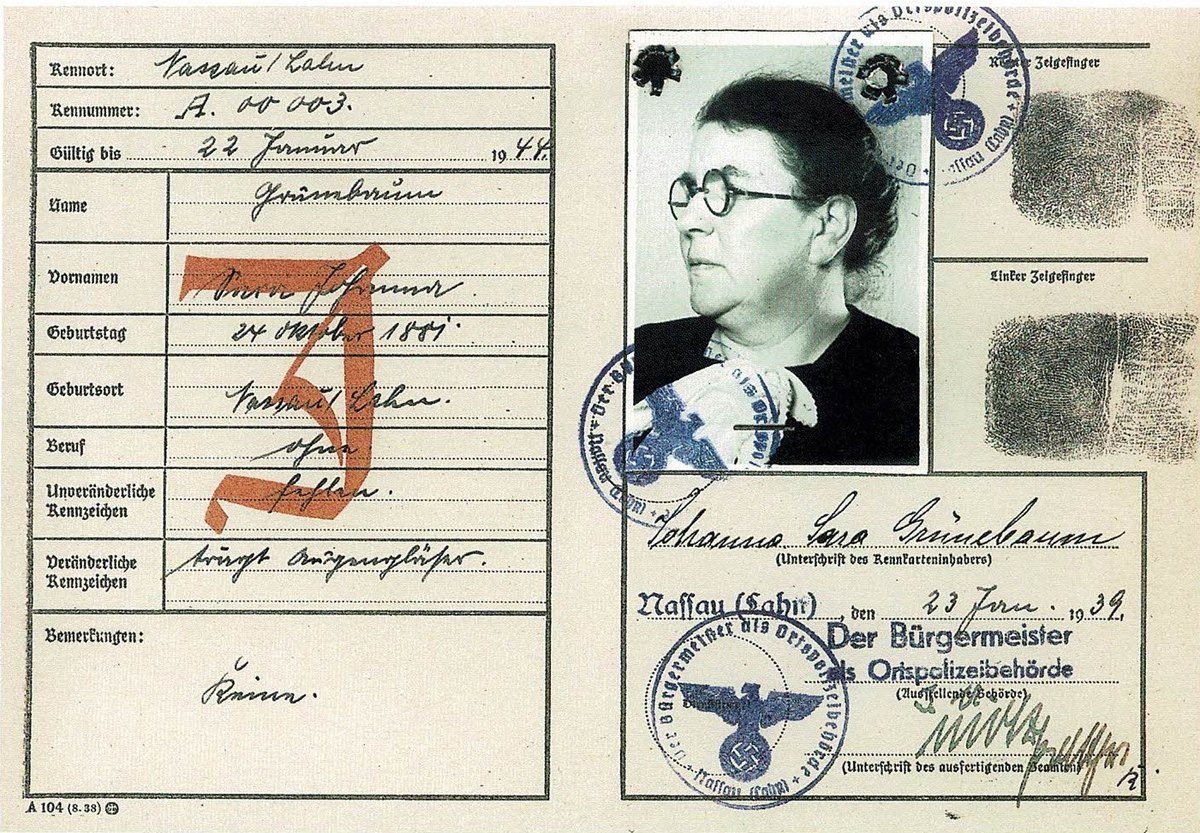
She got out almost at the last minute. On July 4, 1941, she boarded the Siboney in Lisbon for New York. Her children in America had prepaid the $378 fare. That October the deportations from Frankfurt began, and emigration was banned the same month. The crates holding the rest of her belongings went from Frankfurt to Rotterdam and were never seen again. Johanna joined her daughter Ruth in Greensboro, and she died there on December 4, 1944 (Becker-Hammerstein and Becker, Julius Israel Nassau (2002), p. 190). A copy of her ship ticket survives in Nassau (Obermayer Award nominations, 2011).
Alone in Holland
At fourteen, with help from a family friend, Hans left Germany by himself. He found work in a bakery in Apeldoorn, the trade that would carry him through the next ten years.
It was due to a friend of our family I was sent to Holland at the age of 14. I was all alone and obtained a job in a bakery in Apeldoorn, Holland. I worked for two years here.
Paris and the World's Fair
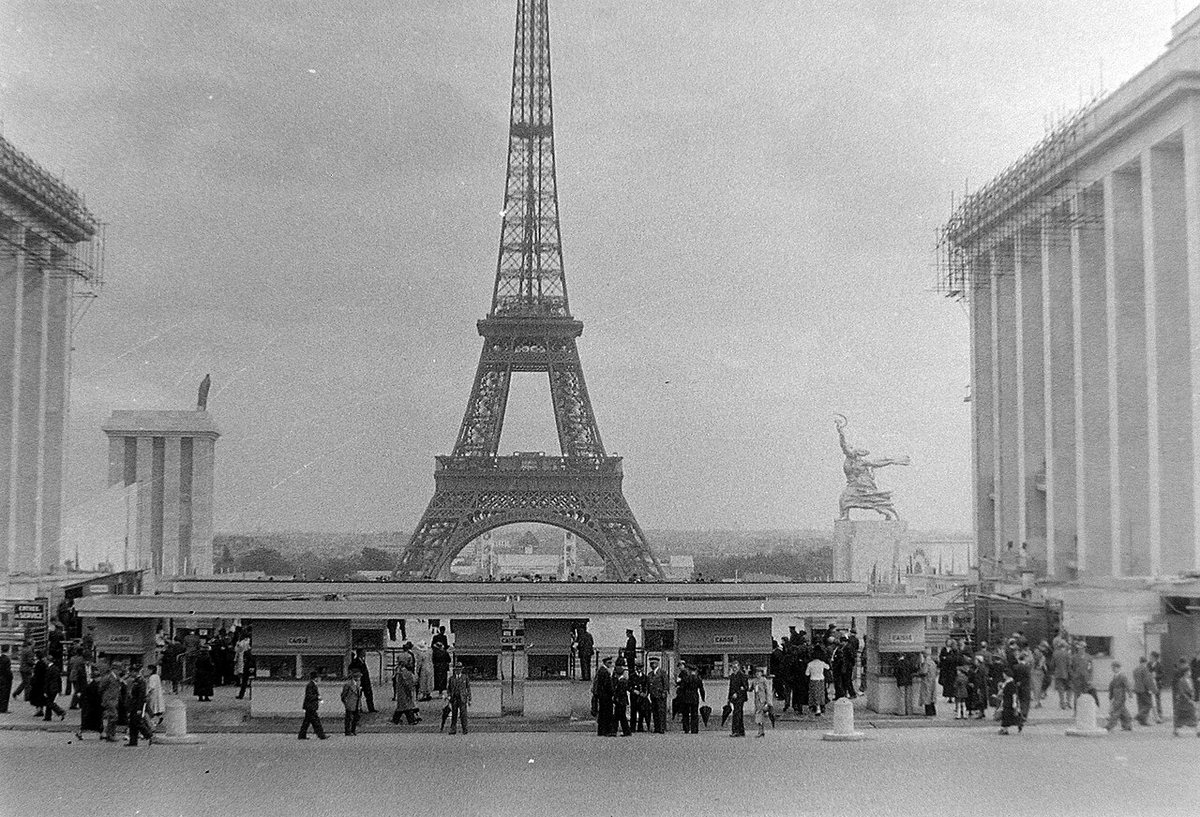
His oldest brother had also fled Germany. Hans joined him in Paris and spent six months making candy at the 1937 Paris International Exposition.
After two years I left for Paris, France to see my oldest brother. He also had to leave Germany or be sent to the Concentration Camps. For six months I worked in Paris at the World's Fair making candy.
The Route to North Carolina
From the Rhineland to Holland, then Paris, then across the Atlantic to New York, and finally south to North Carolina. Relatives in Greensboro sponsored his papers. Tap a stop to follow the route.
From Nassau to North Carolina, 1934–1939
Lines connect the places he named and do not show actual travel paths. His port of departure in Europe is not recorded.
Arrival in New York
Hans arrived on November 11, 1937, at seventeen, without a word of English. By his second day he had a job. He spent the next year and a half baking through the night in Manhattan.
My life was now again to change. Through relatives in Greensboro, N.C. I was able to obtain my papers to go to the United States of America. On November 11, 1937 I landed in the ‘Promised Land’. I could not speak a word of English and a cousin had to get me off the boat.
On November 11, 1937 I landed in the ‘Promised Land’. I could not speak a word of English and a cousin had to get me off the boat. — John Green
I had an address of a boy that had worked for an uncle in Germany as a baker. I called this man and I had a job on my second day in New York. I worked once again in a bakery on Columbus Avenue. This was a short distance from a room I had on Lexington Avenue. This job was hard. It was long hours, from 9 pm to 10 or 11 am. After six months at this job, I found a new one. For a year I was employed in a cake shop on Broadway and 181st Street.
South to Carolina
An uncle from California brought Hans and his sister Ruth to North Carolina. After two weeks in Mount Airy and a year at Draughon Business School in Winston-Salem, his uncle died, and the young immigrant answered the employment office's question with a single word.
After this year, my uncle from California came to New York on business. My sister, Ruth had also arrived in the United States. He said we should go to North Carolina. We spent two weeks in Mount Airy and then my uncle told me he wanted me to go to school in Winston Salem, N.C. I attended Draughon Business School for one year. My uncle passed away after this year and I was forced to find employment.
The first thing I did was go to the N.C. Employment Office. I told the man I was looking for a job. He asked ‘What kind of job?’. I said “Anything!”. I was instructed to go to the Ball Park and sell score cards and ice cream and Coca-Cola. I did this. Two nights later, this same man was at the Ball Park and said on Thursday, Friday and Saturday I could work at a Shoe Store. This was all fine with me.
He asked ‘What kind of job?’. I said “Anything!”. — John Green, at the N.C. Employment Office
Finding the Salvage Business
A chance conversation in a bakery got him into the salvage yards, and he stayed in that work for the rest of his life. He went on to run Southern Converting Company's Winston-Salem branch and then moved to Brenner Industries.
One evening, as I was in a Bakery, I met a man and as we talked of what we did, he offered me a job. It was working on Monday, Wednesday and Thursday in a Salvage Yard. This job was right up my alley! For a while I continued working all three jobs. After a few weeks I was hired full time at the Salvage Yard.
It was not long before I was asked to take over the operation of Southern Converting Company of Greensboro in their Winston Salem branch. A few months later the operation was bought out by Brenner Industries in Winston Salem. I then transferred over to Brenner Industries. I did so enjoy this line of work. I began at the bottom learning the business and worked my way to the top in my own Salvage Yard, many years later.
Fort Bragg and Camp Hood
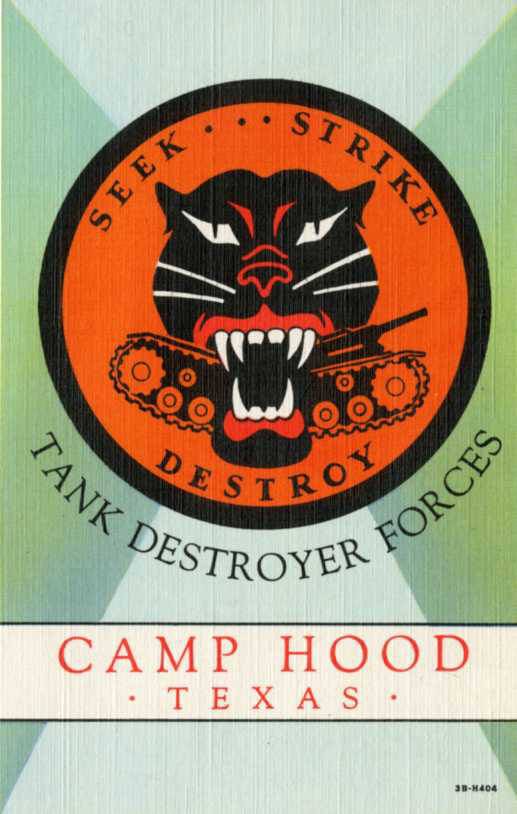
Drafted in 1941, the former baker volunteered in the kitchen on his first Thanksgiving at Fort Bragg. That led to cooking, then teaching cooks at Camp Hood, Texas, and then a post as supply sergeant with the 611th Tank Destroyer Battalion.
In 1941, the President of the United States sent me notification to enlist in the United States Army. I was glad to do my part for my country. In October, I came to Fort Bragg, N.C. to take my Basic Training at B-14-5 RTC. On Thanksgiving Day, our cook was intoxicated and could not fulfill his duty. My Company Commander asked for volunteers to assist in the kitchen. Having been a Baker, I volunteered.
After Basic, I was stationed at Fort Bragg as a Cook. In 1943, I was sent to Camp Hood, Texas as an Instructor in a Cooking School. Upon arrival at my Company, my CO asked if I could take over the Supply Room. With his assistance, I accepted. After seven months, I was once again relocated to the 611 TD Battalion at Camp Hood, Texas as a Supply Sergeant. During this time, I also took training in the field.
Return to Europe
In 1944, the boy who had fled Germany went back as an American soldier. He was assigned to the Military Intelligence Service, which trained many German-speaking refugees for intelligence work, and served from Normandy into Germany and Austria.
The war years, 1941–1945
The England marker is approximate, because the speech does not say where in England he landed. Normandy is marked at the invasion coast.
In May we received our orders for Europe. On the train I was informed that I was the Acting 1st Sergeant until we arrived in Europe. We landed on D-Day in England. We received 20 days training and then arrived in Normandy, France. I was assigned to MIS to do my schooling in Germany. I served under four Generals; General Eisenhower, General Bradley, General Patton and General Clark.
Dachau, Munich, and Vienna
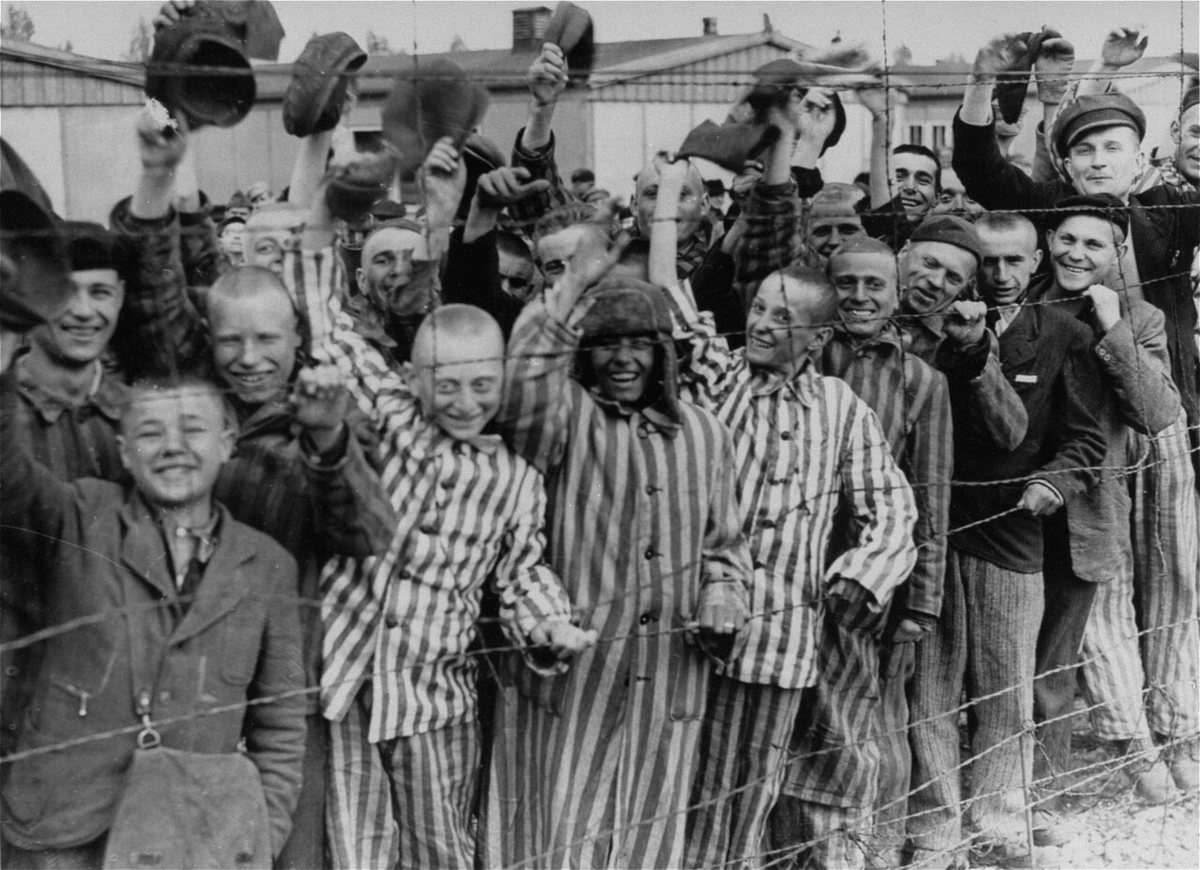
The German-Jewish refugee was among the first American soldiers to enter Dachau. He received the Bronze Star for undercover work in Munich with the XV Corps.
I was one of the first GI's to liberate the Concentration Camp at Dachau. — John Green
I was one of the first GI's to liberate the Concentration Camp at Dachau. I was awarded the Bronze Star for undercover work in Munich for the XV Corps. We were then sent to Vienna to meet the Russians.
Ursula
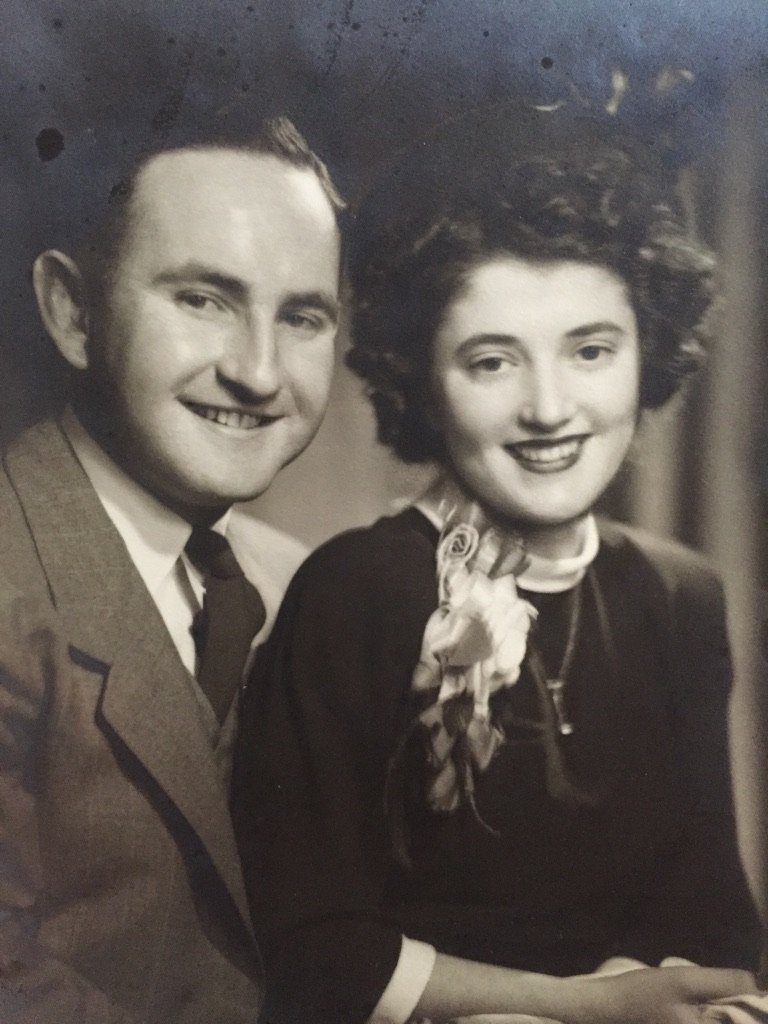
On the last two days of a ten-day furlough in England, he met the girl of his dreams. They had one date, wrote letters for more than a year, and married four days after she arrived in America.
After the war in Europe had ended, I was given a 10 day furlough in England. On the last two days, I met the girl of my dreams. It was love at first sight. This was it! We had only one date and on Saturday I returned to Vienna. We corresponded with one another for some time. In December, 1945 I was discharged from the Service, and returned to Winston Salem, to my old company, Brenner Industries and my old job. I was not very happy. I missed Ursula, the girl I had met [in England], and I wanted to go into business for myself.
On the last two days, I met the girl of my dreams. It was love at first sight. This was it! — John Green, on meeting Ursula
I needed to remedy these situations. After six months, I wrote to Ursula and proposed. It took another nine months for her papers to clear. She arrived on a Saturday and the following Wednesday, February 19, 1947 we were married.
Cohen & Green Salvage Company
He had his Army savings, one truck, one wrecker, and a partner he trusted: Harold Cohen, his former supervisor and a veteran of the Pacific. Together they bought a Fayetteville salvage yard. One rule built their name: every bill paid by the tenth of the month.
John Green's North Carolina
As I stated I wanted to be in business for myself. I checked the trade papers and located a Salvage business for sale in Fayetteville, N.C. The next Sunday I drove to look over the business, speak to the owners and negotiate a price. With only a limited amount of money which I had saved in the Army, price was a major factor. While in Winston Salem, I had worked with Harold Cohen. At the time, he served as my Supervisor for Southern Converting Company. He had also returned from the Service in the Pacific. We decided to become partners and we bought out the Lesson Salvage Company in Fayetteville.

It was very difficult in the beginning. We had one truck and one wrecker. Our first employee, Lee Smith is still with the Company. We changed the name to Cohen and Green Salvage Company and established several Company policies. All bills would be paid by the tenth of each month. By doing the above, we established extremely high credit with others.


All bills would be paid by the tenth of each month. — The founding policy of Cohen & Green
After 30 years of wonderful success and friendship, I purchased my partner's, Harold Cohen, interest in the business. I now put my two sons, Michael and Ronald, into the business. We expanded to Raeford and Lumberton, North Carolina. I have been very fortunate to have these two men to continue in the goal I set for myself years ago. They continue to live and work by the standards that were originally established when I went into business for myself.
Family and Faith
He was proud of his children's education and his daughter's work with children with learning disabilities. He also wrote plainly about his heaviest losses, the death of his oldest son and the loss of both legs, and about the faith that carried him through.
I also have a daughter living and working in Raleigh, N.C. She is a Special Educator of Learning Disabled Children. I believe she has learned from my wife and I, the true meaning of helping the less fortunate and the act of giving to others. All of my children have brought me much happiness and pride. I am also proud each of my children were able to complete their formal education through college.
Not all things in my life have gone the way I expected. G-d made me aware and have faith. I lost my oldest son at the age of eleven in a bicycle accident. My wife and I have never lost faith in G-d. I am a double amputee, walking on two artificial legs. I have never asked, “Why me?”. I get along fine. I see people in wheelchairs, not able to walk at all. I am thankful for the many joys life has brought to me.
I have never asked, “Why me?”. I get along fine. … I am thankful for the many joys life has brought to me. — John Green
A Helper and a Giver
In Fayetteville he served his synagogue, his fellow veterans, and his neighbors, including helping to found one of North Carolina's first schools for Black children with disabilities.
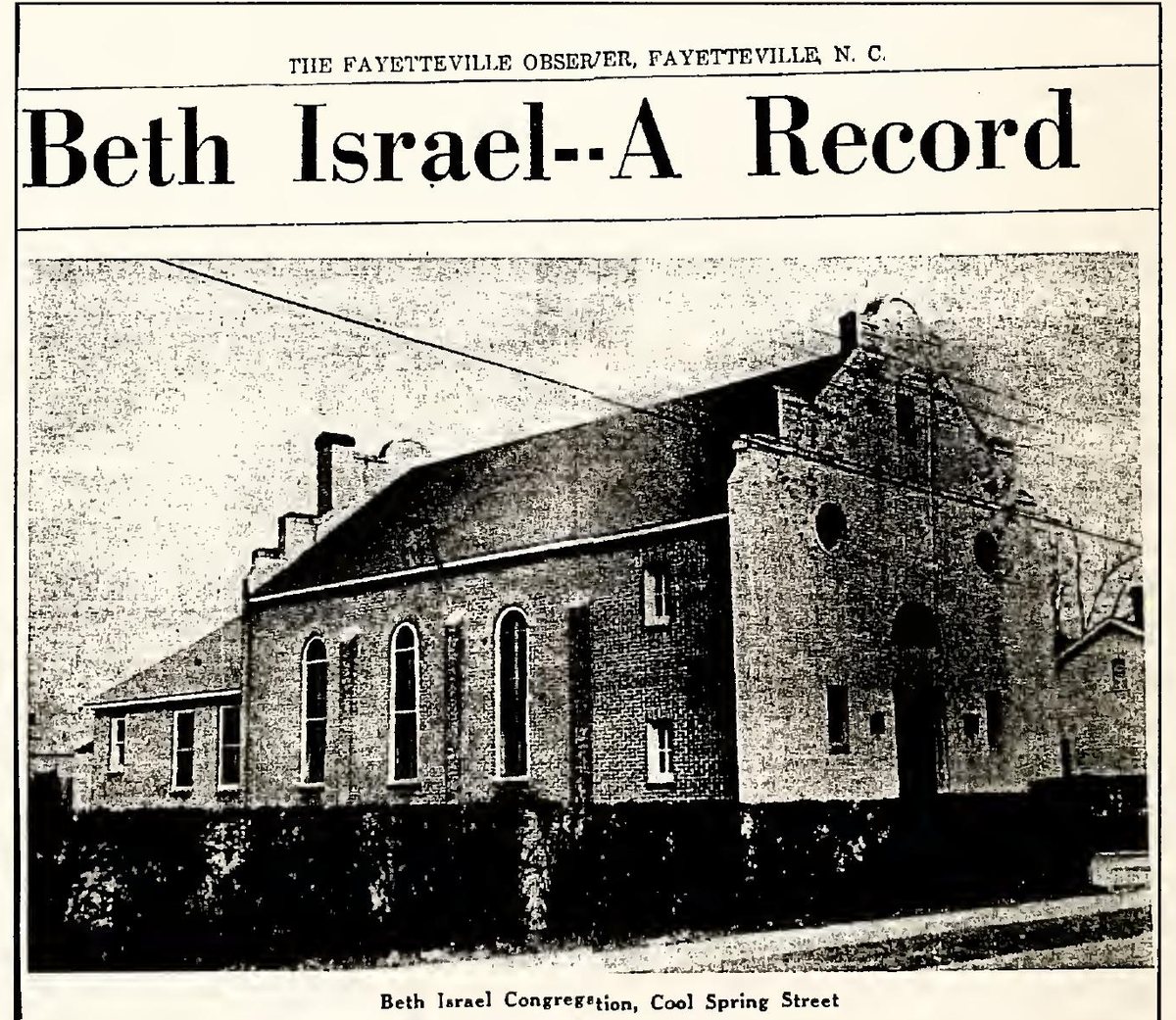
Throughout my life in Fayetteville, I have been able to do many things. I have been very involved with my synagogue, Beth Israel Congregation. I have served as Building Chairman, Treasurer, member of the B'nai B'rith Lodge, and an officer and still serving on the Beth Israel Burial Society. I am a helper and a giver to others who cannot help themselves. I have been able to do this in several means. I was one of the founders of the first black handicap schools in North Carolina; The Fuller School for Exceptional Children. I was a member of the Jaycees and have been extremely involved with the Salvation Army in Cumberland County, in which I received the ‘OTHER’ award. I was Vice Commander of the American Legion, Chef de Train of the 40-8. I have also served on the Board of the North Carolina Old Age Home in Winston Salem.
- Beth Israel Congregation: Building Chairman, Treasurer
- Beth Israel Burial Society: officer
- B'nai B'rith Lodge: member
- Co-founder, The Fuller School for Exceptional Children
- Jaycees: member
- Salvation Army, Cumberland County: ‘OTHER’ award
- American Legion: Vice Commander
- The 40&8: Chef de Train
- Board, N.C. Old Age Home, Winston-Salem
I give charity from my heart, no strings attached and G-d has always seen fit to give it back to me in some mysterious way. — John Green, on what he credited for his success
With Gratitude
He closed his speech by thanking the people around him: Ursula first, then his partner, his sons, and the employees who stayed with the company for decades.
In conclusion of my story, I thank my wife; for believing in me, for supporting me and giving me encouragement in all my endeavors in our 37 years together. Without Ursula beside me, I do not feel my life or accomplishments would have the meaning they do.
I also want to thank the many people of Cumberland County and Fayetteville, my many friends and customers of Cohen and Green Salvage Company; the people of Raeford and Raeford Salvage Company and the people of Lumberton and Lumberton Recycling Company. Not last nor least, I thank Harold for being a partner for 30 years and my key employers, my sons, Michael and Ronald, part owners and general managers for all three salvage yards. Thanks go to Mr. Melvin Dove, another former partner and still working with us; my Office Manager, Mr. Thomas Bennett and Lee Smith for 38 years of dedicated service to the company. I thank the newest member to our established business, Mr. Johnny Parsek, Manager of our Lumberton Recycling Company. With all the people mentioned above, I could not have done what I have without the many employees who made theirs and my dream come true. Through their many years of hard work and loyalty, this endeavor would never have been accomplished.
Cohen & Green Salvage Company has been doing business the old fashioned way and we are proud of what we earn. We are proud of our reputation. We, the company and staff have over 100 years experience in the Salvage, Converting, Demolition and Recycling business. I feel we are the BEST in this part of the country. Thank you to all who aided in making this statement true!
Advice to Those Who Come After
As advice to others who will come after me, don't ever turn a job down and always be the best at what you can do. I truly believe if all of us lived life more by the Ten Commandments, we would all have a better world to live in. — John Green
Thank you all and G-d Bless You.
Remembered in Fayetteville
His own speech is modest about his public life. A History of Beth Israel Congregation and the Jewish Community in Cumberland County fills in more of the story. The book quotes a profile of John by local radio reporter Johnny Joyce, along with recollections from Ursula's sister.
That profile says John was born in Coblenz in 1920. It credits him as “the founder of the Fuller School for Exceptional Children, which was the first school of its type to be opened in North Carolina to assist handicapped black children.” It also notes that he received one of the Salvation Army's highest honors “because he had done so much so many times for the service.” The congregation's list of community honors records this as the Others Award, in 1984. He was vice commander of the American Legion and served many other community organizations (Beth Israel history).
At Beth Israel he served for decades as a trustee, treasurer, chairman of the building committee, and vice president. Board minutes from the 1950s thank “Harold Cohen & John Green of Cohen & Green” for donating the steel used to build the rabbi's home. In his later years, diabetes cost him both legs. The profile says he “learned to walk with artificial legs and still remained active” (Beth Israel history).
Ursula Green came here with John and proceeded to be a part of the leadership of the synagogue. — A History of Beth Israel Congregation
Ursula was also a German Jewish refugee. Her sister, Lotte Wertheim, recalled that after Kristallnacht the two girls “were lucky to get a ‘Kinder Transport’ to England.” When their mother was interned on the Isle of Man as an enemy alien, Ursula went with her. Lotte and their mother later moved to Fayetteville to be near Ursula. In Fayetteville, Ursula led women in Sisterhood and Hadassah, volunteered at the hospital, and baked for every occasion. Before each High Holy Days she polished the silver on the Torah decorations (Beth Israel history).
John Green died on May 1, 1984, at age 63, one week before his 64th birthday. He is buried in Fayetteville's Cross Creek Cemetery #4. The cemetery records list him with Ursula (1925–1999) and their son Jeffrey Allen Green (1948–1960) (Cross Creek Cemetery #4 records). His speech mentions “our 37 years together,” so he likely wrote it in the last months of his life.
Also mentioned in Down Home: Jewish Life in North Carolina, which says John and Ursula “became community and congregational pillars.” Some details in these accounts differ from his speech. They say relatives brought him to Greensboro, while the speech says he landed in New York and went to Mount Airy.
The Legacy Continues
Cohen & Green was founded in Fayetteville in 1946. John's sons, Michael and Ronald Green, ran the business together for more than five decades as part owners and general managers, and they grew it into a regional processor of ferrous and non-ferrous scrap metal. The brothers expanded it to yards in Fayetteville, Lumberton, and Raeford, which employed more than 100 people (CityView, 2024; The Gotham, Discarded). Michael served as CEO at the time of the sale. Together with Raeford Salvage and Lumberton Recycling, the companies handled about 80,000 gross tons a year before they were sold to Recycle South in 2008 (GlobeNewswire, 2008). The yard at 445 Glidden Street appears in the 1957 Fayetteville city directory under “Harold K. Cohen, Pres. — John H. Green, Sec.-Treas.” (Hill's Fayetteville City Directory, 1957).
His grandson Steven Green tells the family story of immigrant determination and recycling in the documentary project Discarded.